The Stefan-Boltzmann swimming pool
 Marcin Polkowski
Translated from Polish. Originally published on morony.pl on 10 Jul 2010.
Part 2 of 2 in the series Garden pool physics
- Practical thermodynamics – the swimming pool, part 1
- The Stefan-Boltzmann swimming pool
I already wrote about the thermodynamic adventures of my garden pool earlier (almost a year ago). The conclusion back then was that once you limit evaporation by covering the water surface with bubble wrap (so that it floats and sits right on the water), you're left with 3 ways for energy to flow between the pool and its surroundings: conduction and convection, radiation, and solar energy. I eliminated solar energy from today's experiment by taking measurements only at night. Earlier observations suggested that the effect of conduction is much smaller than that of radiation.
Water radiates???
Every body with a non-zero temperature (on the Kelvin scale!) radiates energy. The power of this radiation (that is, energy per unit time) is described by the Stefan-Boltzmann law: , where , and is the effective surface area. This formula only makes sense in a space where there is nothing except the body in question. Under earthly conditions we have surroundings, which radiate too. In our experiment we have a pool surrounded by air. The radiated power can of course be negative (when the pool is cooling because it radiates more than it receives from its surroundings) or positive (when the pool is warming up). Whether it's positive or negative is a matter of convention – which direction you call positive. I chose the one above.
Going further, we have radiation in both directions, and its net power can be calculated from the formula: , where is the air temperature and is the pool temperature.
The experiment – formulas
Knowing the air and water temperatures, we can calculate the average power resulting from radiation. The temperature is measured continuously and then averaged in 5-minute blocks. For each block between 11 pm and 4 am the power was calculated, and all the values were averaged. The calculations were done without taking the effective surface area into account, which will shortly serve as a test of the whole theory.
On the other hand, knowing the initial and final temperature of the pool, its volume and the specific heat of water, I could calculate the (again, average) power of heat exchange for each night. I used the formula , where is the initial temperature at 11 pm, is the final temperature at 4 am, , .
The experiment – results
So we have the power calculated in two ways. One value is the actual power, and the other is the power resulting from radiation alone. Assuming that radiation is the only source of heat exchange, the relation should hold.
I collected good data from 31 nights. By good I mean nights with no gaps in the measurements and with the pool covered by the bubble wrap. The plot below shows the relationship between the calculated power values (since all the power values were negative, I flipped their sign on the plot for readability):
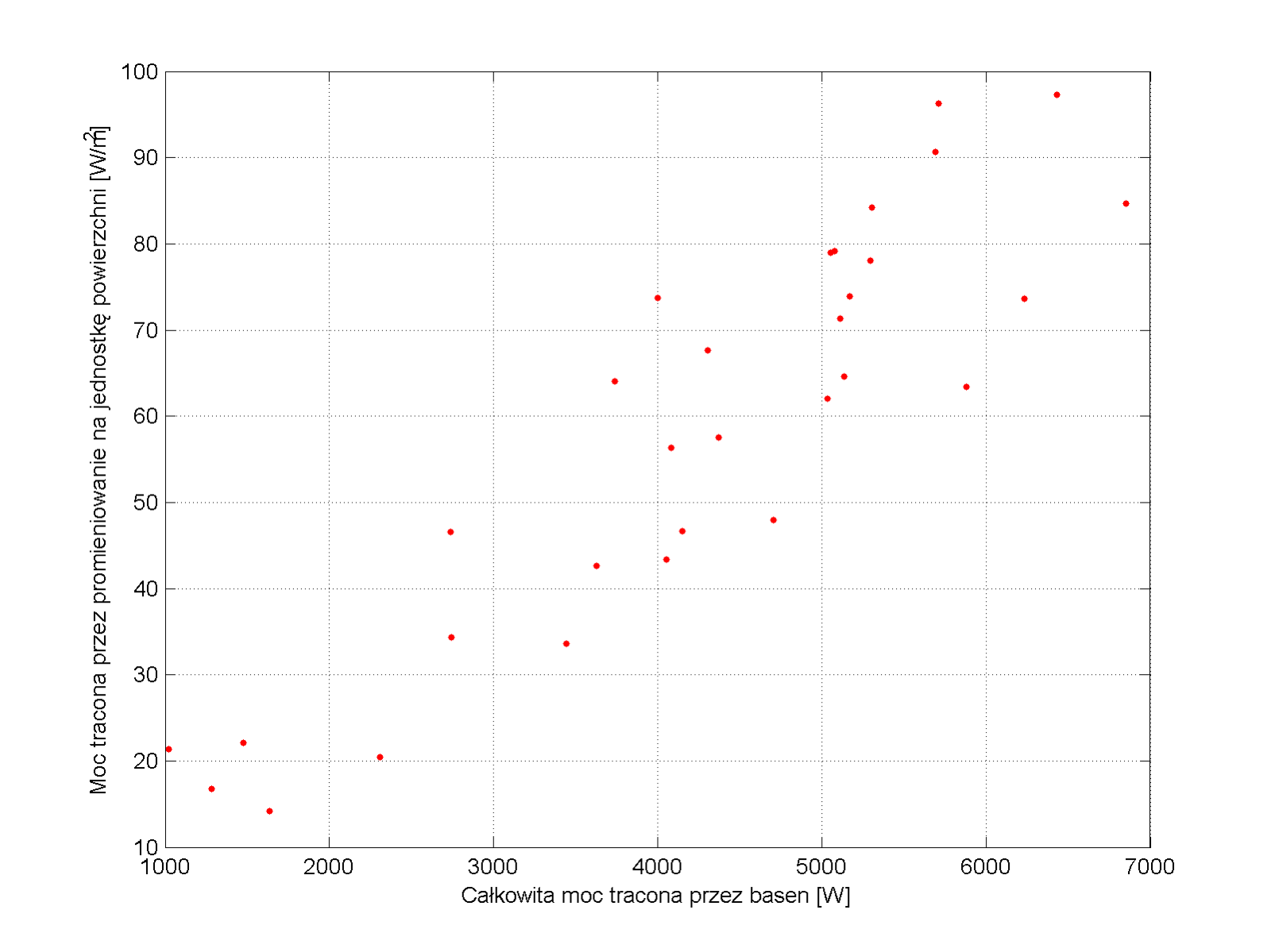
What remains is to determine the effective surface area from these data. We'll do it by fitting a straight line through the point (0, 0) to the data. We get .
How does this compare with reality? The pool measures 7.5 x 3.5 x 1.15 meters, which gives a total surface area of 77.8 square meters. As you can see, these values can be considered consistent (of course, a proper error analysis should be done!).
Summary
It's confirmed that physics works not only in the lab. My hunch that radiation is the key factor behind the loss of heat (without sun and evaporation) also seems to make sense.
Of course, the reasoning above involves some approximations. First, the pool is not a perfect black body but a gray body. Second, the radiation values differ for the different surfaces (top, sides, bottom). Since the result is much better than I expected anyway, I won't spend time and space on a deeper analysis of the errors in these assumptions.
That was the last part of Garden pool physics. Start from part 1