Smog sensors: mine vs. Airly – a first comparison
 Marcin Polkowski
Translated from Polish. Originally published on morony.pl on 6 Mar 2018.
Part 2 of 2 in the series Smog sensors
- Building your own smog sensor #1
- Smog sensors: mine vs. Airly – a first comparison
As I mentioned before, there are 7 devices I built running in Legionowo near Warsaw, measuring the amount of particulate matter in the air. All the measurements are collected and neatly presented by the website zatruci.pl. Ever since the site launched, I have been hearing official statements from the local authorities about the poor quality of the measurements, glaring errors, inflated readings and so on. You really have to see it for yourself:
In short: my cheap sensor is worthless because it showed something different from an even cheaper sensor.
Over time things quieted down a bit, but only for a while. In February it turned out that the town had bought two sensors from Airly. Airly is the leader of the Polish market (or so it seems to me) for "cheap" air quality sensors. I'd be careful with the word "cheap", though, because they charge 1,500 zł net per sensor plus a 50 zł monthly subscription. And what do you get for that? The device measures particulate matter concentration, temperature, pressure and humidity, and sends the data to a server. It uses a cellular connection for transmission – hence the monthly subscription. So maybe at that price you get some fancier laser particulate sensor? I couldn't find any information anywhere on which sensor Airly uses, but I think you can see it in their promotional video (especially from the 28-second mark, where the sensor module shows up in two shots):
In my opinion it's the PMS5003 sensor. It is very similar to the one I use in my devices (SEN0177). So where does Airly have the edge? In that, according to them, their sensors are calibrated to agree with the professional instruments used by the Chief Inspectorate of Environmental Protection (GIOŚ). I've heard the accusation many times that my sensors don't take air humidity into account and count droplets of condensed water as dust. In my view, if humidity were to affect the measurement at all, it would be through the swelling of moist particles, not some mythical droplets. So how does Airly handle it? On their own website they say three interesting things:
- What is the measurement error? The measurement range for PM2.5 given by the manufacturer is 0-500 μg/m³. The measurement accuracy given by the manufacturer is ±10%@100-500 μg/m³ and ±10 μg/m³@0-100 μg/m³.
- How does the device respond to moisture? Doesn't water vapor condensation make the results less accurate? A comparative analysis against a station of the Voivodeship Inspectorate for Environmental Protection (WIOŚ) showed no effect of temperature, humidity, pressure or water vapor condensation on the measurement results.
- Why do your sensors read higher/lower than the nearby measuring stations of the Voivodeship Inspectorate for Environmental Protection? (…) Our devices were calibrated against a WIOŚ station over a period of 12 months.
In short: humidity is not taken into account, and the data are "normalized" based on a comparison with WIOŚ instruments. As I understand it, the comparison was done for some group of sensors, and it is applied to the rest on the assumption that all sensors from this manufacturer behave the same way. We know nothing about this normalization. We also don't know how the results shown on their website are calculated – over what time period they're averaged, in what way, and so on.
The town used one Airly sensor to verify my sensors – they placed it next to my sensors in different parts of town for a dozen or so hours at a time. A nice idea, but unfortunately Airly released the data from these measurements with values every 60 minutes – very sparse! Despite this inconvenience, a quick look at the data shows that my sensors show higher concentrations.
In parallel with these tests, one of the people who bought a sensor from me buys a private Airly sensor and installs it right next to mine. From my own sensors I have every individual measurement, every dozen or so seconds. From Airly I have their converted / corrected / normalized result recorded every 15 minutes. Let's compare the records from the last few days, with the sensors standing side by side.
Comparison 1: Airly measurement vs. individual measurements from my sensor: 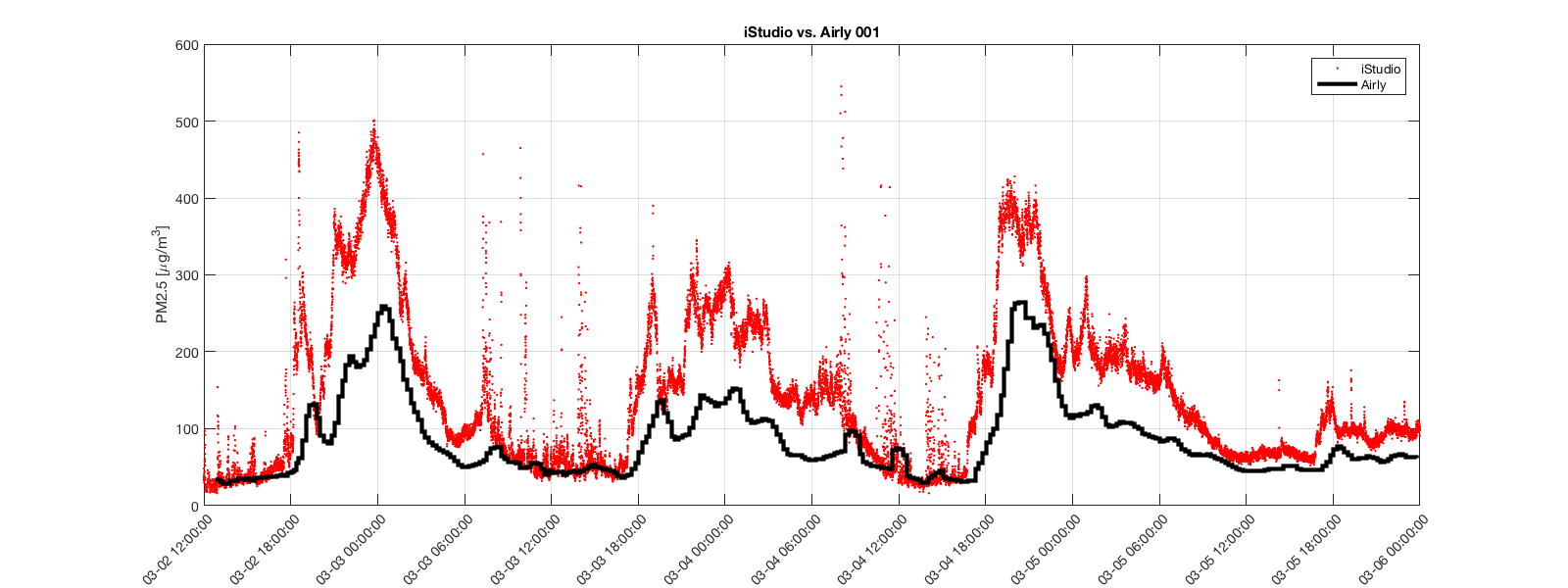
Comparison 2: Airly measurement vs. averaged measurements from my sensor (the average of the preceding 45 minutes): 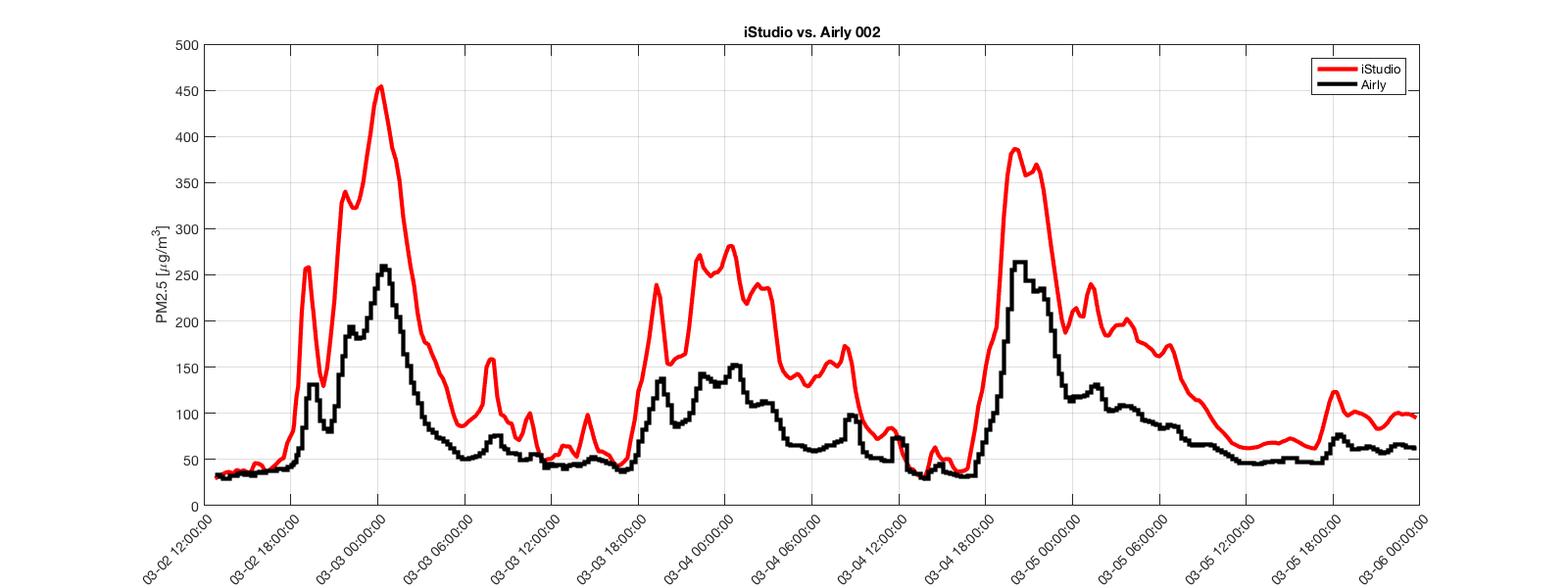
Since the shapes of the two curves are very similar, I started wondering what the simplest way would be to make them agree. After a few iterations I arrived at a satisfactory result. I multiplied my measurements (already averaged) by a factor whose value depends on the dust concentration: for concentrations from 0 to 20 µg/m3 the factor equals 1. For concentrations from 20 to 90 µg/m3 it decreases linearly from 1 to 0.6. For concentrations from 90 to 1000 µg/m3 it decreases linearly from 0.6 to 0.5. Here is the comparison after the conversion: 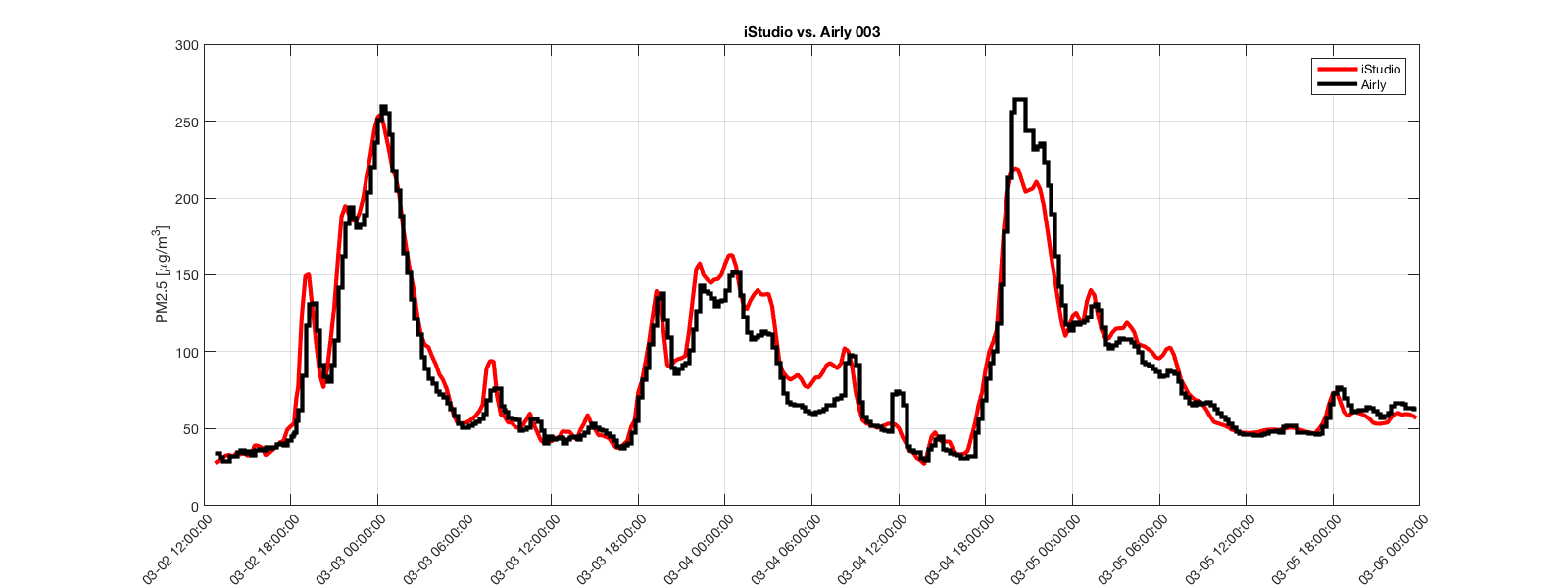
It comes out beautifully, but what can we conclude from it? This is where I have a problem. Since Airly doesn't use temperature, humidity or pressure to bring its measurements in line with the WIOŚ stations, all they are left with is a factor that depends on the concentration alone. Analogous to the one described above. The question is whether this kind of approach is legitimate. Why would small laser sensors systematically overestimate concentrations like this? Which measurement is true and reliable? I'll leave the question open for now, but I promise to come back to it!
That was the last part of Smog sensors. Start from part 1