The precision of reading / recording a GPS position
 Marcin Polkowski
Translated from Polish. Originally published on morony.pl on 20 Feb 2009.
Whenever satellite navigation comes up, people talk about the accuracy of receivers. Anyone who uses GPS units (maybe not the car ones, but hiking and professional ones) knows that a receiver's accuracy (in determining horizontal position) ranges, depending on conditions (sky visibility, speed), from 20 meters down to as little as 2 meters.
In most receivers, data between the chip that determines the position and the part responsible for presenting the data is sent in NMEA format. Within this format, the geographic position (longitude and latitude) is transmitted like this: 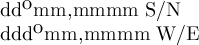
where dd and ddd are degrees and mm is minutes, given to 4 decimal places. How precise is a position written this way? In other words: how many meters is 0.0001 of a minute? Let's work it out right now: separately for latitude and longitude, because, as we know, all meridians have the same length but parallels don't.
Longitude
Every meridian is 20,003,930 meters long. We divide the meridian into 180 degrees, each degree into 60 minutes, and each minute into 10,000 pieces. How long is the smallest piece? The calculation is below:  As you can see, the precision of a longitude written this way is 18.52 centimeters. On the one hand that's a lot, on the other it's not much.
Latitude
Latitude is a bit different, because parallels are not all the same length. The longest parallel is the equator, which is 40,075,016.686 meters long. To calculate the length of the parallel at a given latitude, multiply the length of the equator by the cosine of the latitude angle.
We divide the length obtained this way into 360 degrees, each degree into 60 minutes, and each minute into 10,000 pieces. The length of the smallest piece is calculated with the formula: 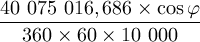
In Poland, the precision of a recorded latitude ranges from 10.69 centimeters in the north to 12.17 centimeters in the south.
What next?
There are, of course, ways to determine a position more precisely than the limits calculated above. That, however, requires measuring the position of a given point many times and averaging the measurements skillfully. One day I'll try to carry out and describe an experiment like that…